Soft-story buildings are among the most earthquake-vulnerable structures in California—but funding is available to help property owners strengthen them. Through the California Earthquake Multi-Unit Retrofit (EMR) program, eligible property owners can receive grants to complete full soft-story retrofits and improve safety.
This blog explains what soft-story buildings are, why full retrofits matter, and how to apply for California soft-story retrofit grants.
What Is a Soft-Story Building?
A soft-story building is a structure with a significantly weaker or more flexible first floor compared to the stories above it. In California, these are often multi-unit wood-frame apartment buildings designed with open ground-level spaces, such as tuck-under parking or large garage openings.
These open areas reduce lateral support at the ground level, making the building especially vulnerable during an earthquake. When seismic forces occur, the weaker first story may not adequately support the weight and movement of the upper floors, increasing the risk of severe structural damage or collapse.
Many soft-story residential buildings in California—typically multi-unit wood-frame apartment buildings with tuck-under parking and living spaces above—were built before modern seismic codes were established. Commonly constructed between the 1950s and 1970s, these structures are especially vulnerable during earthquakes because of weak first-story conditions. Because they frequently house multiple families, including vulnerable populations, their failure can have severe consequences.
FEMA Guidance and Evolving Standards for Soft-Story Retrofits
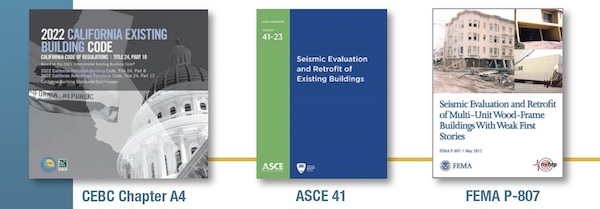
Recognizing this risk, the Federal Emergency Management Agency (FEMA) published FEMA P-807 in 2012 to provide guidance for the seismic evaluation and retrofit of multi-unit wood-frame buildings. The goal was to reduce the likelihood of catastrophic collapse and improve overall building performance during earthquakes. Since then, many California cities have adopted mandatory and voluntary soft-story retrofit ordinances.
Building on that work, FEMA released FEMA P-807-1 in 2023 based on research conducted by the Applied Technology Council. The study evaluated two retrofit approaches: "line-only" retrofits and "full ground-story" retrofits. While some jurisdictions permit line-only retrofits that strengthen only the open-front wall line, these upgrades do not provide the same level of protection as a full ground-story retrofit.
Why Full Ground-Story Retrofits Provide the Best Protection
A full ground-story retrofit strengthens the entire vulnerable first-story level, improving a building's overall seismic performance and reducing the risk of severe structural damage during an earthquake. For this reason, full ground-story retrofits are regarded as one of the most effective solutions for enhancing structural resilience and protecting residents.
Benefits of a full ground-story retrofit:
- Improves overall structural stability
- Reduces the risk of collapse during strong earthquakes
- Protects residents and reduces displacement
- Reduces costly post-earthquake repairs
- Increases long-term property value
Earthquake Multi-Unit Retrofit (EMR) Grants for California Property Owners
To help make these comprehensive upgrades more affordable, the Earthquake Multi-Unit Retrofit (EMR) program offers grants of up to $49,600 for eligible seismic retrofit projects. Because the program is designed to achieve a higher level of seismic safety, EMR funding requires a full ground-story retrofit.
The Structural Engineers Association of California (SEAOC) Existing Buildings Committee also recognizes full ground soft-story retrofits as the preferred standard for achieving optimal structural performance based on current engineering knowledge.
How Property Owners Can Apply for an EMR Grant
Property owners in participating cities can register for an EMR grant between August 19 and September 30, 2026.
Frequently Asked Questions About Soft-Story Retrofit Grants
What is the Earthquake Multi-Unit Retrofit (EMR) program in California?
The Earthquake Multi-Unit Retrofit (EMR) program provides financial assistance to California property owners to complete full soft-story retrofits on multi-unit residential buildings.
How much funding can I receive for an Earthquake Multi-Unit Retrofit?
Eligible property owners can receive up to $49,600 per building through the EMR program, depending on project scope and program requirements.
Who qualifies for an EMR grant?
Owners of qualifying multi-unit wood-frame buildings with soft-story conditions may be eligible, provided they meet EMR program criteria.
Building owners will be able to apply for EMR grants if the building:
- Is located in a program-eligible city that has a mandatory, multi-unit residential soft-story retrofit ordinance (Albany, Berkeley, Mill Valley, Oakland, San Francisco, and San Jose in Northern California, as well as Beverly Hills, Burbank, Culver City, Los Angeles, Pasadena, Santa Monica, Torrance, and West Hollywood in Southern California),
- Is multi-story, wood-framed, and built before 1991,
- Has 5–10 units,
- Has “tuck-under” parking on the ground floor beneath the living area, and
- The building owner has received a notice and order to retrofit from their city, and
- The retrofit is a full ground-floor retrofit in accordance with FEMA P-807, IEBC Chapter A4 (latest edition), or ASCE 41 (latest edition); a line-only retrofit does not qualify for this program. See Program Rules for full details.
What is the difference between full and line-only retrofits?
A line-only retrofit focuses on strengthening the open-front wall line where large parking openings create a structural weakness. While this can improve performance, FEMA research found that it may not address vulnerabilities throughout the rest of the ground floor.
A full ground-story retrofit strengthens the entire weak first story, creating a more comprehensive seismic retrofit solution that better distributes earthquake forces throughout the structure.