
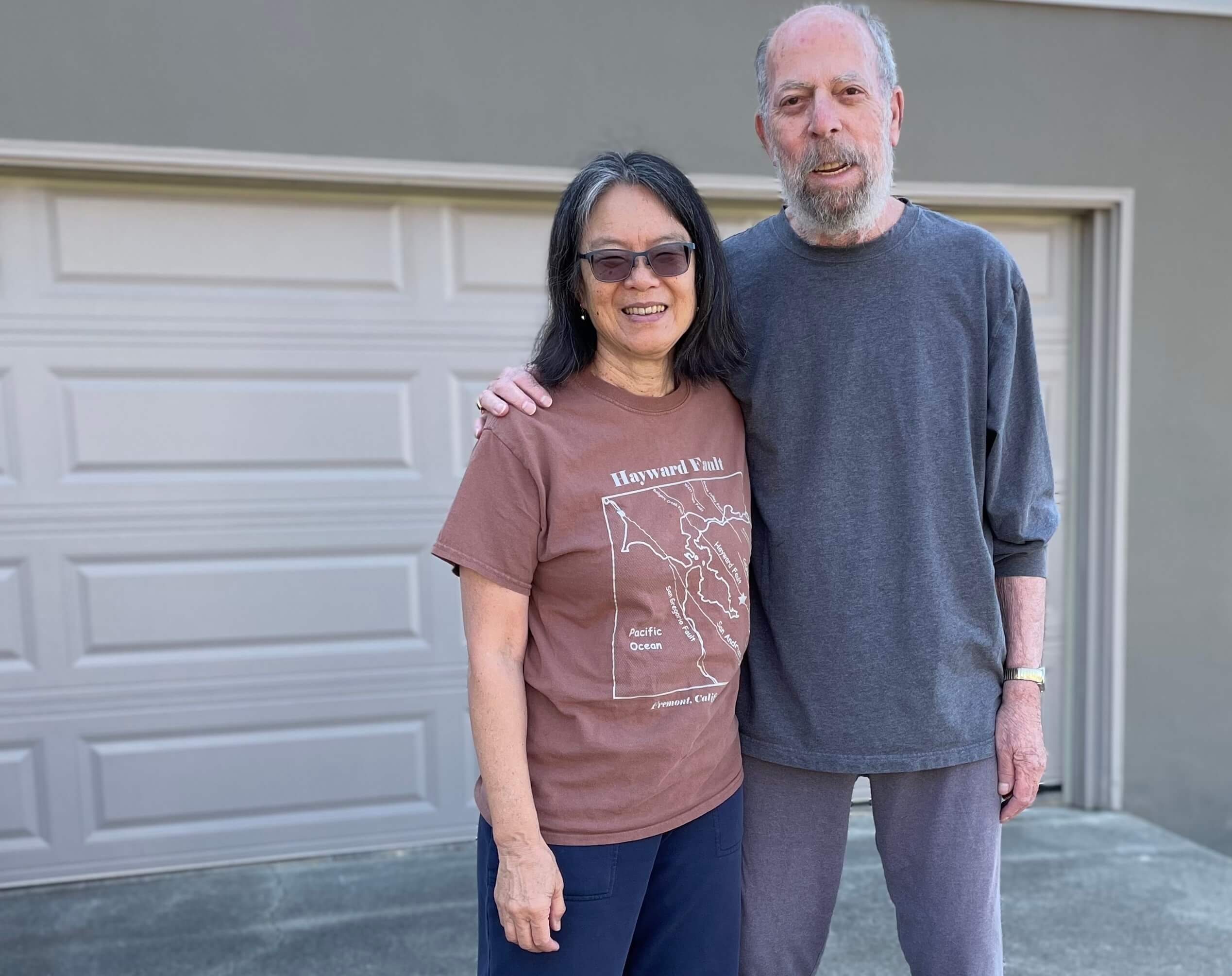
In the late 1990s, Teri and her husband, Fred, knew they needed more space for their family. In 1998, they found a split-level house at the bottom of a hill in Oakland and made it their home. Built in 1955, the house was close to the Hayward Fault and predated modern seismic building codes. From the start, Teri and Fred understood it might not be earthquake-ready.
Deep-rooted Bond
Teri’s lifelong connection to California earthquakes kept the risk front of mind. “I grew up in California and was living in southern California when the Sylmar Quake hit in 1971, the biggest quake I had experienced,” she recalled. “I was running in and out of rooms in the house in my PJs feeling so scared at the time.” Years later, she and Fred experienced the 1989 Loma Prieta Earthquake while living in an apartment. Fred remembered his daily commute on the Cypress Freeway, which collapsed that day: “Typically, when I would be heading home from work there would be a lot of traffic on the Cypress freeway. However, the World Series was in town and traffic was lighter.” He made it home early — a twist of fate that kept him off the freeway when disaster struck. “I felt incredibly lucky not to have been on the freeway in that moment,” he said.
Decades later, in 2023, Teri came across an article in the Los Angeles Times about the Earthquake Soft-Story (ESS) retrofit program through the California Residential Mitigation Program (CRMP). “We then visited the CRMP website to explore ESS information and determine if our home fit the parameters for the program.”
Reassurance Would Prove Invaluable
They soon learned their home qualified for an ESS grant. Motivated to move forward, they found a contractor and engineer. “The service with the CRMP team deserved high praise,” they said. “There were many things we were novices about, such as filling out the application correctly and keeping track of a fairly complicated series of expenses. CRMP was friendly, accessible, and very professional. The amount of support provided was a ten-star experience.”
The project, however, was not without challenges. Many contractors they contacted were hesitant to take on the project, saying the work was too complex. Out of eight contractors, five responded, two provided bids, and both suggested bringing in a licensed structural engineer to design a plan that could meet the program’s requirements. “The engineer was very helpful, even willing to redo or refine his plans when it was needed,” Teri said.
The permitting process with the city of Oakland also added delays. Approvals stretched over months, and Teri and Fred had to request multiple extensions from CRMP to keep the project on track. Through it all, they appreciated the program’s steady support. “Mark [CRMP Program Manager] was very helpful and addressed so many questions for us,” they said. “He reached out to us to ensure that we would be paid what was owed. High praise to Mark in this process.”
When the retrofit was finally complete Teri and Fred felt relief and gratitude. Most importantly, their home — and their peace of mind — was stronger.
Today, Teri and Fred share their story with friends, family, and neighbors. “There is a need for retrofitting in our neighborhoods,” they said. “We hear and are aware of the struggles for some in the community, and we hope that the retrofit programs are available to all who are interested. Continue to get the word out there, CRMP!”